
A Century of Phantom Excellence
Celebrating the Phantom from 1925–2025 — Every Generation, One IconRolls-Royce Phantom Centenary 1925–2025
For one hundred years, the Rolls-Royce Phantom has been more than a motor car. It has been a symbol – of arrival, of achievement, and craftsmanship elevated to an art form. From the first model in 1925 to today’s modern masterpieces, from Kings and Queens to captains of industry, film stars, dignitaries and dreamers, the Phantom has carried those for whom “good enough” was never an option and. transformed the whole chauffeur-driven experience.
Launched in 1925 and still in production today, the Phantom is the longest-running luxury nameplate in automotive history. Across eight generations it has evolved with the world around it, yet its core purpose has never changed: to offer the most refined, most serene, and most exquisitely crafted way to travel on four wheels. As Rolls-Royce themselves put it, the Phantom embodies an “unwavering pursuit of perfection” – a promise that has defined an entire century of motoring.
A modern verdict
“The Rolls-Royce Phantom is quite simply the best car in the world.”
– Jeremy Clarkson, motoring journalist and former Top Gear presenter
The Name That Launched a Thousand Dreams
The original 1925 Phantom was a post-war masterpiece that set the standard for Rolls-Royce luxury for generations. Before you even reach for the technical specifications, the Phantom begins with a feeling – and a name. “Phantom” is not a number or a code. It suggests presence without heaviness, grace without noise, mystery without menace. It is a word that hangs in the air like a story.
Say it, and you see things: moonlight on polished coachwork, a silver figurine leaning forward on the bonnet, a long silhouette gliding through mist in near silence. The Phantom doesn’t need to shout. It arrives – and when it does, conversations pause and cameras quietly appear.
That quiet confidence is why the Phantom became the car of royal households, maharajahs, statesmen, entertainers, and entrepreneurs. It was never just a way to get from A to B. It was a moving statement of taste, influence and intent.

1925 – The Birth of a Modern Legend
When the first Phantom – often referred to as the “New Phantom” or Phantom I – appeared in 1925, it succeeded another legend: the Silver Ghost. That was no small responsibility. The Silver Ghost had already built Rolls-Royce a reputation as the maker of “the best car in the world”.
Henry Royce’s answer was simple and uncompromising: “Take the best that exists and make it better.”
The Phantom I featured a more powerful and sophisticated engine, hushed running refinement and a chassis designed to carry the most luxurious coachwork of its day. Even in a world still recovering from the First World War, this was confidence made tangible. Early owners included heads of state, industrial magnates and society figures who understood exactly what it meant to arrive in a Phantom.
Coachbuilt Grandeur and the “Magic Carpet Ride”
In the early decades, a Rolls-Royce Phantom was never really “finished” when it left the factory. The chassis and engine were supplied by Rolls-Royce, but the bodywork was entrusted to a coachbuilder – names such as Park Ward, Barker, Hooper and Mulliner. These firms didn’t simply install panels and seats; they created rolling works of art for each individual owner.
Every Phantom body was a collaboration between engineer, designer and patron. Rooflines, door styles, glass, veneers, fabrics, inlays – all could be tailored. Some cars were stately limousines intended for state processions. Others were elegant town cars for evenings at the opera. Some, ordered by wealthy patrons in India and the Middle East, were almost palatial: hand-engraved, gilded and overflowing with bespoke details.
Underneath, though, one thing was constant: the way it moved. Owners and chauffeurs began speaking of the Phantom’s ride in the same way equestrians describe a perfectly balanced horse – smooth, poised, almost floating. Long before the phrase was formalised in marketing, people were already calling it “the magic carpet ride”.

Between Wars and New Worlds – Phantoms II & III
As the world changed between the 1920s and 1930s, the Phantom evolved with it. The Phantom II, introduced in 1929, combined a refined version of the engine with an all-new chassis that greatly improved ride and handling. It was perfectly timed for the glamorous inter-war years, when a Phantom outside a London hotel or Parisian theatre announced that something – or someone – important had arrived.
The Phantom III, launched in 1936, was a technical leap forward: the only pre-war Rolls-Royce V12, and a car that blended smooth power with quiet authority. It appeared in the driveways of Hollywood studios, royal palaces and embassies around the world. Its presence in film and popular culture helped cement the idea that “the most luxurious car in the world” was, by default, a Phantom.
Built for Crowns and Coronations – Phantom IV, V & VI
The post-war era brought some of the most exclusive Phantoms ever made. The Phantom IV, introduced in 1950, was produced in tiny numbers and reserved almost exclusively for royalty and heads of state. It was never offered to the general public, at any price. To have a Phantom IV in one’s garage was to sit on a very short list indeed.
The Phantom V and Phantom VI continued this tradition of coachbuilt grandeur. Built mainly as limousines with towering rooflines and immense glass areas, they carried monarchs to state openings of parliament, presidents to inaugurations and newly-weds from cathedrals to cheering crowds. These cars were more than transport; they were part of the visual language of power and ceremony.
By the time Phantom VI production ended in the early 1990s, the world had changed dramatically. New safety standards, new technologies and changing customer expectations made it clear that the next Phantom would need to be re-imagined from the ground up.

The Quiet Pause – and the Rebirth at Goodwood
After the final Phantom VI left the line, there was a noticeable silence. For more than a decade, there was no new Phantom. The marque went through a period of transition, and the world wondered what would happen next.
The answer arrived in 2003.
Under the stewardship of BMW, Rolls-Royce Motor Cars opened a new home at Goodwood in West Sussex, England. The first car to emerge from this light-filled, modern facility was the Phantom VII – a car that needed to do more than simply succeed the old Phantom. It needed to reassert what a true flagship luxury car could be in the 21st century.
The result was spectacular. The Phantom VII combined a hand-built 6.75-litre V12 engine with an aluminium spaceframe chassis and a cabin finished with traditional craftsmanship: real veneers, deep lambswool rugs, hand-stitched leather and the now-famous “gallery”-like dashboard. Only a small number of robots were used in production; much of the work was still done by hand.
The Series II update refined the formula further, adding modern lighting, updated infotainment and subtle exterior changes while keeping the unmistakable Phantom proportions. The Extended Wheelbase (EWB) version transformed the rear compartment into a rolling lounge, with legroom to rival a private jet.
It was during this era that many modern commentators – Clarkson among them – began to say openly what the Phantom’s most devoted admirers had known all along: if you wanted the best car in the world, this was it.
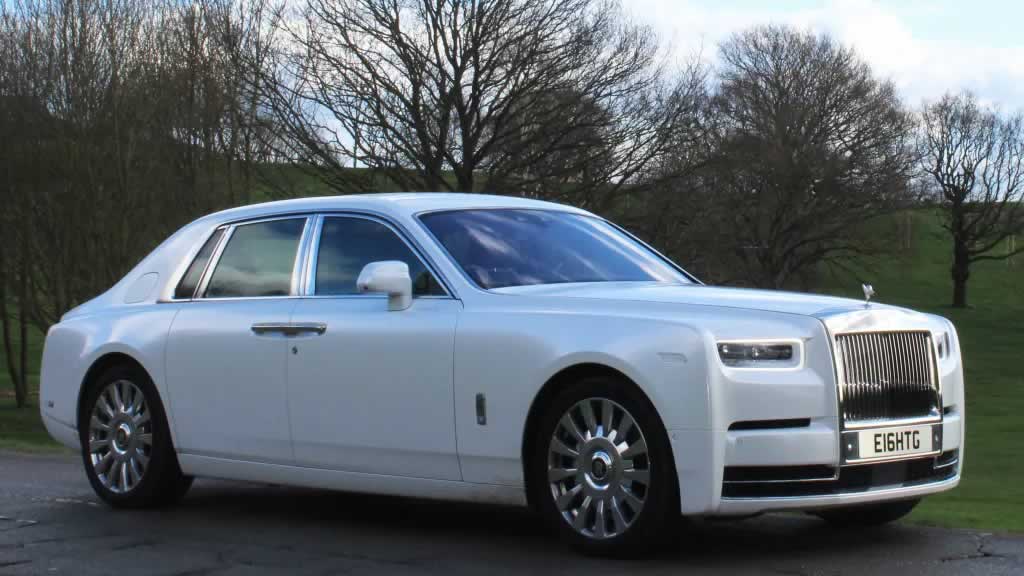
Phantom VIII – The Architecture of Luxury
The current generation, Phantom VIII, made its debut in 2017. Built on the marque’s bespoke “Architecture of Luxury” aluminium platform, it moved the Phantom into a new era while preserving everything that made its predecessors special.
Under the bonnet sits a twin-turbocharged V12, tuned not for drama but for effortless, near-silent power. The body structure is lighter yet more rigid, allowing engineers to refine the ride and reduce noise even further. Rolls-Royce famously added so much sound-deadening material that they had to dial some noise back in, after early test drivers reported that complete silence felt strangely disorientating.
Inside, Phantom VIII is designed around what Rolls-Royce calls “The Embrace” – the feeling passengers experience as the coach doors close and the outside world recedes. The cabin becomes a sanctuary: soft light, fine materials, deep seats, and a level of fit and finish that remains unmatched.
While technology has advanced – with discreet driver assistance systems, high-resolution displays and connectivity – it is carefully hidden behind traditional craftsmanship. The result is a car that feels timeless, not tied to any particular gadget or trend.
Silent Power Meets Electric Silence – Phantom in the Future
No centenary story in the 2020s can ignore one of the biggest questions in motoring: electrification. Governments around the world have signalled dates after which new petrol and diesel cars will no longer be sold. Luxury manufacturers, including Rolls-Royce, have had to decide how they will respond.
In 2022, Rolls-Royce unveiled the Spectre – the marque’s first all-electric production model. It is not called “Phantom”, nor does it replace it, but it shows clearly where the company is heading. Rolls-Royce has publicly committed to having a fully electric product range by the end of this decade.
At first glance, electricity and tradition might seem at odds. In reality, they are perfectly aligned with the brand’s long-held goals. From the very beginning, the Phantom has been about quietness, smoothness and effortless torque. An electric powertrain, with its instant but silent surge of power, is a natural fit for that philosophy.
Will there one day be an all-electric Phantom IX? Only the engineers at Goodwood know for sure. But it is not hard to imagine a future where the “magic carpet ride” glides forward under electric power, continuing the Phantom’s story in a way Sir Henry Royce himself might well have approved of: taking the best that exists – and making it better.

Phantom Lore: Fascinating Facts, Myths & Stories from 100 Years of Rolls-Royce History
Across a century of craftsmanship, the Rolls-Royce Phantom has collected stories as refined, unusual and captivating as the car itself. Here is a curated selection of the most intriguing — from royal secrets to engineering wonders.
1. Who Bought the “First Phantom”?
Like all great legends, the story of 'who bought the first Phantom I (1925) has three equally compelling versions:
- Clarence Gasque, the American-born retail magnate, commissioned an extravagant interior inspired by Versailles, complete with gilding and tapestries.
- Howard Hughes, the Hollywood icon and aviator, is widely credited as the first high-profile celebrity Phantom owner.
- Several Indian maharajas, placed some of the earliest orders for heavily customised cars. The image above is one such example.
Rather than contradicting each other, these overlapping accounts reflect the instant international prestige of the Phantom from the moment it launched.
2. The Rarest Phantom Ever Built
Only 18 Phantom IVs were ever produced, all strictly reserved for royalty and heads of state. Not a single example was offered for public sale,making it the most exclusive Rolls-Royce model in history.
3. The Phantom That Refused to Die
A well-documented Phantom II has travelled over 600,000 miles on its original engine. No restoration — just relentless reliability — a remarkable testament to Rolls-Royce longevity.
4. The Last True Coachbuilt Phantom
The Phantom VI, produced until 1991, was the final Rolls-Royce to be entirely coachbuilt by hand without robotics, A true end of an era.
5. Phantom VII: A New Age, Still Handmade
The Phantom VII marked Rolls-Royce’s Goodwood renaissance in 2003. Only three robots were used in production — and then only for precision welds — everything else was hand-finished by expert craftspeople.
6. The Quietest Rolls-Royce Cabin Ever Created
The Phantom VIII features over 130 kg of insulation, acoustic double glazing and foam-filled tyres, specifically for this model. Early prototype testing revealed the cabin was so silent that engineers added soft background sound so passengers didn’t feel disoriented.
7. Architecture of Luxury
Phantom VIII introduced Rolls-Royce’s bespoke aluminium spaceframe chassis called the Architecture of Luxury, engineered to eliminate vibration at a near-scientific level. It now underpins the entire modern Phantom, Cullinan, Spectre, and future electrified models.
8. Designed for Speed — Even in the 1920s
The Phantom II was the first Rolls-Royce engineered for high-speed cross-continental touring. Tested extensively on challenging Alpine routes, it was widely praised for its stability.
9. Custom Coachwork Without Limits
From the 1920s to the 1960s, early Phantom customers commissioned spectacular one-off bodies and coachwork, including:
- hunting cars with bespoke gun racks
- state landaulettes for ceremonial use
- opera-going town cars
- open tourers for tropical climates
- elephant-proof bumpers and safari fittings
Not one looked quite like another.
10. Churchill and the Phantom
Sir Winston Churchill used several Rolls-Royces — including Phantom III and IV models — during his years in office, for official state functions and diplomatic events.
11. A Phantom on Skis
One extraordinary 1930s commission involved fitting a Phantom with front skis and rear tracks for an Arctic expedition — perhaps the most unusual Phantom ever commissioned.
12. Generations of Craftsmanship Passed Down Through Generations
Many artisans at Goodwood, even today, learned their craft from colleagues who worked on Phantoms in the 1970s, 80s and 90s, preserving a direct lineage of skill and techniques through several generations.
13. A Family Heirloom, Not Just a Car
Some Phantoms have remained with the same families for generations, and linked to family history as much as engineering excellence. More treasured than paintings or jewellery, they are carefully preserved, polished, and passed down to the next generation.
14. The Phantom on Screen
Phantoms appear in Downton Abbey, The Crown, James Bond, The Great Gatsby, Batman, The Godfather and many more Hollywood productions. It often plays itself: the global symbol of dignity, wealth or intrigue.
15. The Spirit of Ecstasy — Nearly Unchanged Since 1911
Aside from aerodynamic refinements in 2022, the Spirit of Ecstasy remains one of the most enduring and recognisable automotive mascots in the world — a guardian spirit unchanged in essence for 113 years.
16. Rolls-Royce and the Electric Future
Rolls-Royce has committed to an all-electric lineup by 2030. With the Electric Spectre, already launched, many expect the future Phantom IX to be fully electric — and to glide in absolute silence — perhaps the most Phantom-like evolution imaginable.
17. The Champagne Glass Test
During a gruelling 15,000-mile endurance trial, Rolls-Royce famously balanced a champagne glass on a Phantom’s bonnet to demonstrate mechanical serenity and smoothtness. The glass never moved. Test or theatre? Perhaps both — and that is exactly the point.
18. A Century in the Public Imagination
From royalty to film directors, statesmen to collectors, the Phantom is more than a motor car — it is a century-long thread woven through culture, ceremony, cinema and personal histories around the world.
A Century Behind Us — and the Next One Waiting to Begin
A hundred years after the first Phantom glided out of Derby, the legend stands taller than ever. Put simply, the Phantom is not just a vehicle model line. It is a living thread running through cinema, politics, fashion, business and family histories all over the world. It has survived wars, recessions, revolutions in engineering, and three full eras of automotive history — yet it has never once lost its composure, its purpose, or its power to make the world fall silent as it passes.
You don’t really understand a Phantom until you sit in one, close the door, and feel the outside world fall away. Reading about it and seeing it in photographs can only go so far. The real magic lives in the way it moves, the stillness of the cabin, the sense that your journey has become part of a story that began in 1925.
The future may be electric. It may be autonomous. It may be unlike anything Rolls-Royce’s founders could ever have imagined. But the Phantom has never belonged to the past. It belongs to that rare part of the human imagination that refuses the ordinary.
So here’s to the next century — to the dreams it will ignite, the journeys it will define, and the moments it will turn into memories. The Phantom’s story is far from finished. If anything… the most exciting chapter is still to come.
About This Centenary Tribute
This centenary article was written from the perspective of someone who loves craftsmanship, heritage and the quiet magic of a beautifully made machine. It reflects a lifelong appreciation of both horses and motor cars – of how a well-trained thoroughbred or a perfectly engineered Phantom can glide, balance and carry you in a way that feels almost effortless.
In the end, that is what this story celebrates: not just 100 years of a famous nameplate, but a century of people who believed that “taking the best that exists and making it better” is still a goal worth pursuing.

Meet the Author
Gail Kingswell Trueman
Automotive & equestrian writer, lifelong enthusiast, and founder of 1LG Digital. Gail blends technical insight with a storyteller’s eye — bringing heritage, craftsmanship and the spirit of great marques to life.
Experience the Phantom for Yourself
There is nothing quite like stepping into a Phantom and feeling the outside world fall away. From weddings and VIP transfers to red-carpet events and special celebrations, our chauffeurs ensure every journey is effortless, elegant and unforgettable.
Discover our modern Rolls-Royce Phantom fleet below.
- • Rolls-Royce Phantom VIII Series I Hire
- • Rolls-Royce Phantom VII Series II Hire
- • Rolls-Royce Phantom VII Series I Hire
- • Rolls-Royce Phantom Overview
- • Luxury Wedding Car Hire
- • Limo Hire Services
However you imagine your perfect journey, one thing is certain — you will remember your first Phantom moment.
Book your Chauffeur-Driven experience today
Hire the Rolls-Royce Phantom Today
The Rolls Royce Phantom is our most popular chauffeur-driven luxury hire car. Perfect for all occasions, no other vehicle comes close to the style & presence of a Phantom. Whether you choose the Series 1, Series II, or the latest model VIII Phantom, because we own our fleet, booking with us is straightforward — simply tell us the date you require, vehicle model, pick up & destination, itinerary + any special requests, such as ribbons or extended waiting time, and we'll provide a tailored quote. Rolls-Royce hire prices vary by day, distance + any extras required. Go on — book your Rolls-Royce experience today.
01992 663338 or 07548 685960